The Seven Yogic Chakras: A Deep Dive into Energy Centers, Their Meanings, and How to Activate Them
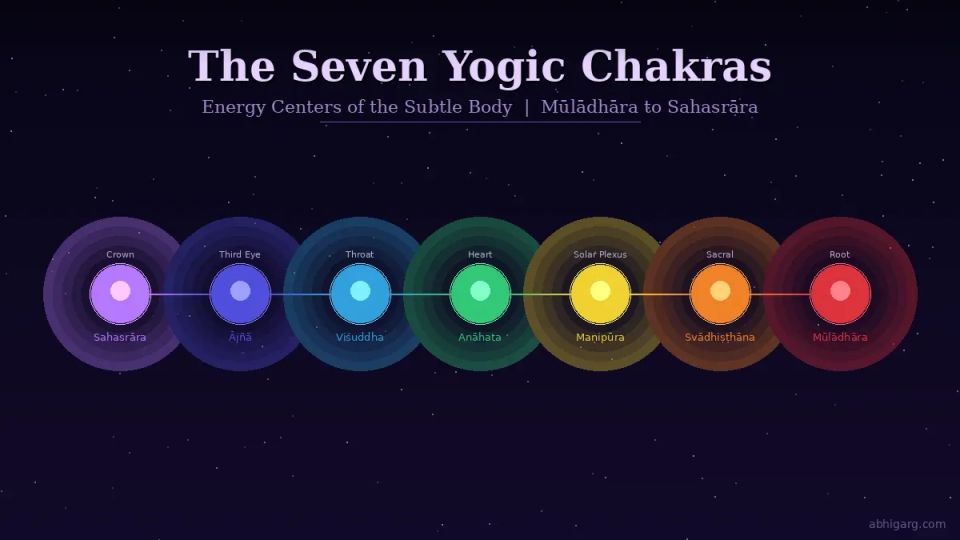
Most people have seen the colorful diagram - a human silhouette with glowing orbs stacked along the spine. Each one gets a color, a feel-good affirmation, and a crystal recommendation. And most people, if they're honest, find it a little hard to take seriously.
Here's what that version leaves out: the chakra system is not a New Age invention. It is codified in texts like the Ṣaṭ Chakra Nirūpaṇa ("Description of the Seven Chakras," composed circa 1577 CE by Pūrṇānanda Yati) and the Haṭhapradīpikā (15th century CE by Svātmārāma), both rooted in centuries of Tantric practice. The concept appears across the Yoga Upaniṣads, the Śiva Saṃhitā, and the Gorakṣa Śataka. In the classical Tantric tradition, chakras are not metaphors for personality types or moods. They are specific junctions in the sūkṣma śarīra (the subtle body) where prāṇic energy concentrates with enough intensity to shape both physiological function and psychological experience.
Understanding them at that level changes the conversation entirely.
Before the Chakras: The Three Nāḍīs
You cannot understand the chakras without first understanding the system they sit within.
The Yogic tradition describes approximately 72,000 nāḍīs - invisible channels that carry prāṇa through the body, the way rivers carry water across a landscape. Of these, three are primary: Iḍā, Piṅgalā, and Suṣumnā.
Iḍā (lunar, feminine, cooling) runs on the left side of the body. Piṅgalā (solar, masculine, activating) runs on the right. Suṣumnā runs straight through the central axis of the spine, from the base to the crown. The seven main chakras are the points where Iḍā and Piṅgalā crisscross Suṣumnā - creating concentrated energy vortexes at each crossing.
In most people, most of the time, prāṇa flows alternately through Iḍā and Piṅgalā. This is visible in a well-documented physiological fact: one nostril dominates at any given moment, alternating roughly every 90 minutes - a phenomenon called nasal cycling. Suṣumnā, the central channel, is largely dormant. The central project of Haṭha Yoga and Tantra is to coax prāṇa into Suṣumnā - and when that happens, the chakras are activated in sequence.
This prāṇic flow isn't vague mysticism. It connects directly to the five prāṇa vāyus - the five functional currents of life force, each governing a specific region and biological process. The nāḍīs, chakras, and vāyus are not separate systems. They are overlapping maps of the same subtle territory.
Why Seven? (When There Are 114)
The Yogic tradition actually describes 114 chakras in the human body - not seven. Of those, 112 are accessible through practice, and 2 exist beyond the physical form. So why do every tradition and every yoga teacher converge on seven?
Because the seven primary chakras function as the main transformers in the system. Think of the body as an electrical grid - these seven are the substations that govern how energy flows everywhere else. They correspond to major plexuses of the autonomic nervous system, to specific endocrine glands, and to distinct, recognizable ranges of psychological experience. Their selection across traditions is not arbitrary. These seven most directly govern how a human being shows up in the world, from raw survival at the base to pure awareness at the crown.
The Seven Chakras - Properly Explored
What follows is not the color-affirmation version. Each chakra carries a tattva (element), a bīja mantra (seed syllable), an associated sensory faculty, a characteristic set of psychological symptoms when disrupted, and specific practices to reactivate it. That is the actual map.
1. Mūlādhāra - The Root
Location: Base of the spine/perineum
Element (Tattva): Pṛthivī (Earth)
Bīja Mantra: LAM
Color: Red
Endocrine association: Adrenal glands
Mūlādhāra translates as "root support." Its earthen tattva is not incidental - this chakra governs your primal wiring: the body's fear response, the instinct for survival, your relationship with physical safety and material security. When Mūlādhāra is disrupted, you don't feel safe anywhere. The anxiety feels sourceless, the financial worry is chronic, and commitment to a place or a relationship feels impossible. These are not personality flaws. They are signals from the base.
Significantly, Mūlādhāra is where Kuṇḍalinī Śakti lies dormant - the coiled serpentine force whose gradual ascent through each chakra is the central arc of Tantric Yoga. The development of every other chakra depends on what happens here first.
Signs of imbalance: Persistent anxiety, hoarding tendencies, disconnection from the physical body, lower back and joint pain, digestive instability
Activation practices: Barefoot walking on earth (grounding), Pādahastāsana, squatting postures, chanting LAM, grounding visualization
2. Svādhiṣṭhāna - The Sacral
Location: Lower abdomen, approximately 2 inches below the navel
Element: Ap (Water)
Bīja Mantra: VAM
Color: Orange
Endocrine association: Gonads, reproductive organs
The name means "one's own abode" - and this chakra is indeed deeply personal territory. It governs the fluid, adaptive dimensions of experience: creativity, emotion, sensuality, intimacy, and the capacity for genuine pleasure. Water moves, adjusts, and takes the shape of whatever contains it - so does the energy of Svādhiṣṭhāna when healthy.
This chakra has an intimate relationship with vāsanā - the latent impressions from past experiences that quietly steer emotional responses. The mental grooves created by memory and repetition operate largely through this energetic level. For anyone working to understand how unconscious patterns drive behavior, the framework of vāsanā, saṃskāra, and vṛtti is directly relevant here.
Signs of imbalance: Creative blocks, emotional numbness or volatility, guilt, pelvic tightness, difficulty with intimacy
a
Activation practices: Hip-opening āsanas (Baddha Koṇāsana, Pigeon), intentional creative work, journaling, cold-water bathing, chanting VAM
3. Maṇipūra - The Solar Plexus
Location: Upper abdomen, navel region
Element: Tejas (Fire)
Bīja Mantra: RAM
Color: Yellow
Endocrine association: Pancreas, adrenals
Maṇipūra means "city of jewels." The fire element here connects directly to Agni - the digestive fire that processes not just food but experience itself. This is the seat of personal will: your sense of agency, your relationship with ambition, your capacity for decisive action under pressure.
In Sāṃkhya philosophy, the three guṇas are particularly visible at this chakra. An excess of rajas (agitation) manifests as aggression and ego-inflation at Maṇipūra; an excess of tamas (inertia) as lethargy and learned helplessness. Understanding sattva, rajas, and tamas as the qualitative texture of this chakra's energy points toward what balanced Maṇipūra actually looks like: confident, purposeful, and free from the need to dominate.
Signs of imbalance: Chronic fatigue, low self-worth, digestive disorders, need for external validation - or at the other extreme, domineering behavior
Activation practices: Kapālabhāti prāṇāyāma (especially effective for stoking the abdominal fire), Naukāsana (Boat Pose), core strengthening, sunlight exposure, chanting RAM
4. Anāhata - The Heart
Location: Center of the chest
Element: Vāyu (Air)
Bīja Mantra: YAM
Color: Green
Endocrine association: Thymus gland
Anāhata means "unstruck sound" - the cosmic sound that exists prior to any two objects striking each other, audible only in the depths of stillness. This chakra sits at the exact center of the seven, bridging the three lower chakras (survival, creativity, power) with the three upper ones (expression, perception, consciousness). It is, quite literally, the hinge of the system.
The air element is philosophically precise: love, like air, cannot be held by force. The moment you grasp at it, it escapes. What Anāhata opens toward is not romantic or conditional love but something closer to unconditional regard - for oneself and others - as distinct from the transactional exchange that the ego generates from a position of need.
Signs of imbalance: Grief held chronically in the chest, resentment, social isolation, inability to receive love, respiratory issues, and chest tightness
Activation practices: Bhujaṅgāsana (Cobra), Ustṛāsana (Camel), loving-kindness (Mettā) meditation, chanting YAM, intentional acts of giving without expectation of return
5. Viśuddha - The Throat
Location: Throat
Element: Ākāśa (Space/Ether)
Bīja Mantra: HAM
Color: Blue
Endocrine association: Thyroid and parathyroid glands
Viśuddha means "pure." The element of space (ākāśa) marks a significant shift - this is the first chakra whose element transcends the physical four. Sound, language, honest expression, and deep listening are its domain. Viśuddha governs not just how you speak but whether what you say reflects what is actually true for you.
There is a precise yogic insight embedded here: when you speak from the throat alone, you produce sound. When you speak in alignment with the heart and higher centers, you produce truth. The purification implied in the name refers to exactly this refinement - using speech and expression as instruments of clarity rather than noise, performance, or defense.
Signs of imbalance: Difficulty saying what you really mean, compulsive talking as avoidance, a chronically sore throat, inability to speak one's truth in serious situations
Activation practices: Chanting and singing (particularly effective here), Sarvāṅgāsana (Shoulder Stand), neck stretches and release, deliberate periods of silence (mauna), chanting HAM
6. Ājñā - The Third Eye
Location: Between the eyebrows (ajna chakra point)
Element: None - beyond the five physical elements
Bīja Mantra: OM (AUM)
Color: Indigo
Endocrine association: Pituitary gland
Ājñā means "command." In the Tantric tradition, this is the seat of the Guru's instruction - the place where inner guidance and genuine intuition become reliable. Structurally, this is where Iḍā and Piṅgalā, having crisscrossed their way up through the previous chakras, finally merge into Suṣumnā. The fundamental duality - solar and lunar, masculine and feminine, thinking and feeling - begins to resolve here.
What the tradition calls "intuition" at this level is not mystical guessing. It is the quality of perception that emerges when the noise generated by the lower chakras settles sufficiently to reveal the deeper pattern underneath. The connection between this perceptual clarity and the ultimate questions of consciousness is something dharma and quantum consciousness explore in its own register.
Signs of imbalance: Persistent overthinking, inability to trust inner knowing, cognitive fog, rigid literalism, spiritual skepticism that crosses into cynicism
Activation practices: Trataka (candle-gazing), Bālāsana (Child's Pose with forehead grounded), visualization practices, chanting AUM
7. Sahasrāra - The Crown
Location: Top of the head
Element: None / Pure Consciousness
Bīja: Often associated with silence, or the fullness of AUM
Color: Violet / luminous white
Endocrine association: Pineal gland (disputed in classical texts)
Sahasrāra means "thousand-petaled" - the lotus that opens fully only when Kuṇḍalinī completes its ascent through all six lower centers. Where Mūlādhāra is matter, Sahasrāra is pure awareness. Where the root chakra asks, "Am I safe?" the crown simply witnesses, without commentary.
This is not the destination of a weekend retreat. In the classical tradition, Sahasrāra's full opening - what the Yoga Sūtras describe as samādhi and Vedāntic philosophy as mokṣa - is the culmination of disciplined, lifelong practice. The eight limbs of Patañjali's Aṣṭāṅga Yoga culminate in dhyāna and samādhi precisely because they are the systematic preparation that makes this ascent possible.
Signs of imbalance: Spiritual bypassing, dissociation from the body, nihilism, or, on the other end, desperate searching for transcendence that never arrives
of Kuṇḍalinī provides useful etymological and historical background; the tradition's own framing, as presented in Sadhguru's writing on the seven chakras, emphasizes that this force must be approached with preparation, patience, and, ideally,
Activation practices: Extended sitting meditation, deliberate śavāsana (practiced as conscious dissolution), sustained prāṇāyāma, working with an experienced teacher
Kuṇḍalinī: The Force Behind the System
It is impossible to discuss the chakras authentically without addressing Kuṇḍalinī - the dormant Śakti at Mūlādhāra whose gradual awakening and upward movement through the chakras is the central narrative of Tantric Yoga. The Wikipedia overview gives a useful etymological and historical background; the tradition's own framing, as presented in Sadhguru's writing on the seven chakras skilled guidance.
The important point for a practitioner is this: Kuṇḍalinī that rises before the nāḍīs are sufficiently purified and the practitioner is psychologically stable can produce disorientation instead of illumination. This is precisely why the tradition insists on foundation - Yama, Niyama, physical and prāṇic preparation - long before attempting to force open the higher centers.
How to Actually Work With This
The entry point is simpler than most teaching suggests. Start with prāṇa.
Understanding the life force through Prāṇa Śakti - as the active operating energy of the subtle body - is a more grounded starting point than jumping directly to chakra visualizations. When prāṇa circulates well through the main nāḍīs, the chakras tend toward natural balance. The work is not "opening" individual chakras like locks on a door. It is creating the systemic conditions in which they function as designed.
For anyone wondering which approach suits their temperament, an orientation to the major traditions of Yoga is worth the time: Haṭha, Kriyā, and Tantra each address chakra work through different tools and emphasize different entry points.
In practice:
- The lower three chakras (Mūlādhāra, Svādhiṣṭhāna, Maṇipūra) respond best to consistent physical āsana, disciplined lifestyle, and prāṇāyāma
- The middle triad (Anāhata, Viśuddha) opens through emotional honesty, relationship as practice, and mantra/sound work
- The upper triad (Ājñā, Sahasrāra) asks for meditation as a daily non-negotiable and, ideally, a qualified teacher
Conclusion
The chakra system, in its authentic form, is a precise map of how prāṇic energy governs the full spectrum of human experience - from the fight-or-flight wiring at Mūlādhāra to the dissolution of the individual self at Sahasrāra.
These seven centers are not boxes to be "opened" one by one. They are an integrated ecology. Work on one, and you will affect the others. Leave one persistently disrupted and the effects will ripple through your body, your emotional range, your relationships, and your capacity for clear thought.
The chakra tradition ultimately extends one invitation: stop treating the body as a machine and begin working with it as the instrument of consciousness it actually is. In that shift of perspective, what looked like mysticism reveals itself as something else entirely - the most detailed and practically useful map of the inner human landscape that any civilization has produced.
7 Frequently Asked Questions
1. What is the difference between a chakra and a nāḍī? A nāḍī is a channel through which prāṇa flows - there are approximately 72,000 of them in the yogic model. A chakra is a concentrated junction point where multiple nāḍīs intersect, creating a vortex of intensified energy. The chakras are like nodes on a network; the nāḍīs are the connections between them.
2. Are the seven chakras mentioned in the Vedas? Not explicitly in the four principal Vedas. The systematic description of seven chakras appears primarily in the Tantric literature - most comprehensively in the Ṣaṭ Chakra Nirūpaṇa (1577 CE), the Haṭhapradīpikā, and the Yoga Upaniṣads. The concept of energy centers does appear in earlier Upaniṣadic texts, but the full sevenfold mapping is a Tantric development.
3. Can chakras actually be blocked? In the Yogic framework, yes - and "blocked" means that prāṇic energy is either stagnant (under-active) or dysregulated (over-active) at that junction, rather than flowing smoothly. This manifests in recognizable physical, emotional, and behavioral patterns. From a purely contemporary psychology perspective, these patterns map onto well-documented constructs like nervous system dysregulation, emotional suppression, and attachment disruption.
4. Do I need a teacher to work with my chakras? For basic chakra-awareness practices - āsana, prāṇāyāma, mantra - self-directed learning is reasonable. For anything specifically involving Kuṇḍalinī awakening, the tradition strongly advises seeking an experienced guide. The reason is practical, not gatekeeping: prāṇic energy moving through unprepared channels can intensify psychological material in ways that become difficult to integrate on one's own.
5. How do the chakras relate to the three guṇas? The three guṇas - tamas, rajas, and sattva - describe the qualitative texture of prāṇic energy throughout the system. The lower chakras tend to express more tamasic (inert, dense) or rajasic (agitated) energy until purified. The upper chakras trend toward sattva (clarity, luminosity). The goal of chakra work is, in part, the progressive sattvification of the entire system.
6. What is the role of bīja mantras in chakra practice? Each chakra carries a seed syllable (bīja) whose vibrational frequency resonates with that chakra's energy. LAM, VAM, RAM, YAM, HAM, OM are not arbitrary labels - they represent a specific vibrational quality. Sustained, intentional chanting of these mantras is considered one of the more direct methods for activating the corresponding center, based on the principle that sound vibration directly influences the subtle body.
7. How long does it take to "balance" the chakras? This is less like completing a course and more like ongoing maintenance. Most practitioners report increased body awareness and emotional regulation within weeks of consistent practice. Deeper transformations - particularly in the upper chakras - are the work of years to decades, not weekend intensives. The tradition does not promise a finish line; it offers a direction.
==
If this perspective resonates and you want to go further, start with the subtle body's most fundamental mechanism - the life force itself. Explore what Prāṇa Śakti actually is and how to cultivate it, and you will have a grounded foundation for everything the chakra system offers.