Vāsanā, Saṃskāra, Vṛtti, and Karma: The Yoga-Sāṃkhya Map of How the Mind Keeps Repeating Itself
There is a peculiar frustration that comes with self-awareness. You understand, in clear and rational terms, that a certain pattern is not serving you - a reflexive irritability, a tendency to shrink from conflict, a compulsive need to prove yourself through achievement. You understand it, and yet it happens again. Knowing the name of the groove does not stop you from falling into it.
The Sāṃkhya-Yoga tradition had a name for this frustration long before modern psychology did. More importantly, it had an anatomy for it. The ancient teachers identified four distinct but interlocking layers of psychological conditioning - vāsanā, saṃskāra, vṛtti, and karma - and mapped out precisely how each one feeds into the next. This is not loosely spiritual vocabulary. It is a working model of the mechanics of repetition, as precise in its own terms as any clinical framework.
Understanding where one layer ends and another begins is not merely academic. It is the difference between knowing a disease by name and understanding how it actually spreads.
The Four Terms as a Single Cycle
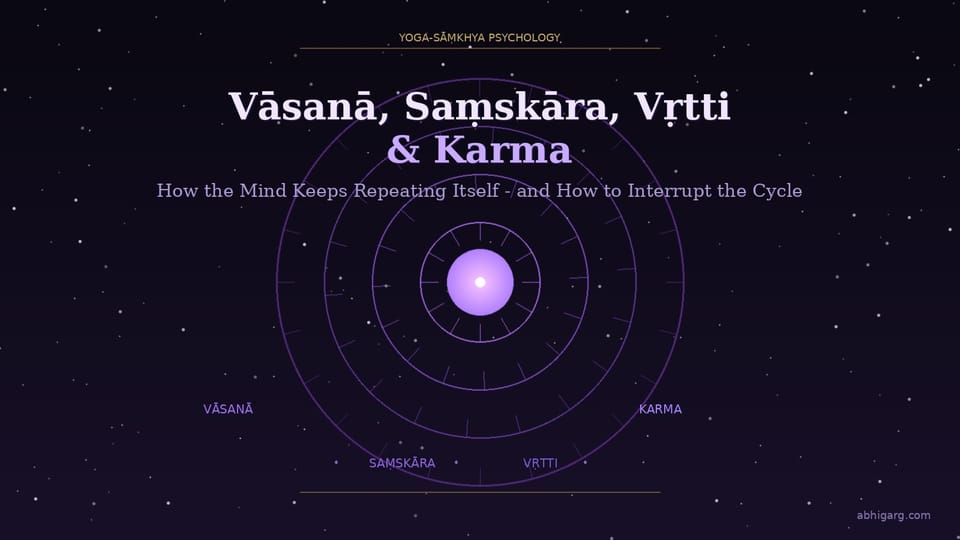
Before unpacking each concept individually, it helps to hold the whole structure in view. These four terms describe a loop, not a list.
Vāsanā is the deepest layer - the near-invisible residue of past experience that settles into the psyche below the level of ordinary awareness. Saṃskāra is the grooved behavioral pattern that vāsanā generates when it takes behavioral form through repetition. Vṛtti is the active wave - the modification that arises in the mind-field when a saṃskāra gets triggered. And karma is the action - inward or outward - that such a wave sets in motion, which in turn generates new residue and closes the loop.
Vāsanā produces saṃskāra. Saṃskāra, when activated, produces vṛtti. Vṛtti, when acted upon, produces karma. And karma, in its deepest sense, feeds back into vāsanā, perpetuating or modifying the whole field. Round and round, across a single conversation, a single life, or across many lifetimes, according to the tradition.
Vāsanā: The Scent That Persists
The Sanskrit root of vāsanā is vas - to dwell, to remain, to perfume. The classical image is vivid: press a flower inside the pages of a book, leave it there, then remove it weeks later. The flower is gone. The fragrance is not.
That fragrance is vāsanā - the subtle impression of an experience that lingers long after the experience itself has ended. It lives not in explicit memory but in something closer to orientation. It does not announce itself as "I remember." It functions more quietly, as "This is how things are."
In the Sāṃkhya map of the inner world, vāsanās reside within the sūkṣma śarīra - the subtle body - at the level of ahaṃkāra, the individualizing faculty that makes every experience feel personal and mine. This is important: vāsanā is not stored information. It is a tilt in the system. A worldview before any particular thought has arisen. Patañjali touches on this in Yoga Sūtra 4.8-4.9, where he speaks of latent impressions arising across lifetimes, activated by similarity - and the vāsanā is the unmanifest ground from which these impressions continuously resurface.
This is also why it is the hardest layer to see. Vāsanā operates below the threshold where introspection typically reaches. It is experienced not as a memory or a habit but as the invisible frame around all experience. The person shaped by a deep vāsanā of unworthiness, for instance, does not think "I have an impression of being unworthy." They simply see the world through that lens, as if it were transparent. This quality of transparency - of being mistaken for reality rather than recognized as conditioning - is precisely what gives vāsanā its grip.
Understanding this layer has direct implications for how we interpret our own instincts, preferences, and apparently obvious assessments of people and situations. You can explore how Sāṃkhya's cosmological map of matter and consciousness connects to this deepest layer of the psyche, since the three guṇas - sattva, rajas, and tamas - are ultimately the material substrate in which vāsanā takes root.
Saṃskāra: The Path Worn Into the Field
If vāsanā is the fragrance, saṃskāra is the path that repeated walking has worn into the grass. The word is built from sam (completely, thoroughly) and kāra (making, doing) - something thoroughly formed, shaped by repetition. In the context of yoga psychology, it refers to the behavioral and perceptual groove that past experience has cut into the citta, the mind-field.
Saṃskāra is the sthūla - the gross or more tangible - form of vāsanā. Where vāsanā is atmospheric and diffuse, saṃskāra is a defined channel. Every time the channel is activated, it deepens. Every time it deepens, it becomes more easily activated. This self-reinforcing quality is why Patañjali says in YS 4.9 that the sequence of impressions remains unbroken even across separations of birth, place, and time - jāti deśa kāla vyavahitānām api ānantaryam.
A saṃskāra is not simply a habit in the behavioral sense. It is, more precisely, a habitual way of being a particular self. It operates through ahaṃkāra - the part of the inner instrument that stamps each experience as "mine" or "not mine," "me" or "not me." This is why old emotional patterns are so resistant to purely cognitive intervention. The pattern does not just govern what you do. It governs who you believe you are while doing it.
Patañjali's celebrated statement in YS 2.16 becomes concrete against this background: heyam duḥkham anāgatam - the suffering that has not yet come is still avoidable. The saṃskāra is the precise mechanism through which past experience manufactures future suffering. It is not fate. It is a groove that can, in principle, be interrupted.
Vṛtti: The Wave That Rises
Vṛtti is the most immediately observable of the four - or rather, it would be, if the observing faculty were itself free enough to see it clearly. The word means fluctuation, modification, whirl, movement. A vṛtti is the event on the surface of the citta field when a saṃskāra is triggered by a suitable stimulus: a wave rises, takes a particular form, and for a moment colors the entire field of perception.
Patañjali opens the Yoga Sūtra with the definition that gives the whole text its organizing purpose: yogaś citta-vṛtti-nirodhaḥ (YS 1.2) - yoga is the cessation of the modifications of the mind-field. He then tells us what happens when those modifications cease: the Seer - the draṣṭā - abides in its own nature (YS 1.3). At all other times, the Seer takes on the coloring of the modification itself (YS 1.4). This confusion of the perceiver and the thing perceived is the root problem that the entire yogic path is designed to address.
In YS 1.6-1.11, Patañjali names five categories of vṛtti: correct knowledge (pramāṇa), false knowledge (viparyaya), conceptual construction (vikalpa), sleep (nidrā), and memory (smṛti). What is striking here is that correct perception is also included. Even a vṛtti arising from accurate knowledge can be kliṣṭa - binding - if it solidifies identification. The problem is not that a vṛtti is wrong. The problem is that it is mistaken for the one who perceives.
The distinction between vṛtti and saṃskāra is therefore structural and temporal. The saṃskāra is the stored potential, the latent groove. The vṛtti is the event, the actual activation of that groove in a specific moment. One is the accumulated disposition; the other is the live instance. And every vṛtti, once it subsides, either strengthens or weakens the saṃskāra it arose from, depending on whether it was met with viveka (discriminative awareness) or with identification.
This is why the direction of practice matters so much. Vṛttis oriented toward clarity leave saṃskāras that support liberation. Vṛttis meet with unconscious identification, leaving saṃskāras that deepen the groove of conditioning. The same mechanism that binds can also release.
Karma: The Action That Closes the Loop
Karma is the most familiar of the four terms in popular culture, and the most consistently flattened. It is not a cosmic ledger of rewards and punishments. In its most precise usage, it means action - but action understood in its complete causal structure: the intention behind it, the act itself, and the impression the act deposits in both the citta and the shared world.
Patañjali addresses karma directly in YS 4.7-4.11, distinguishing four types based on their quality and karmic weight: white (śukla), black (kṛṣṇa), mixed (śukla-kṛṣṇa), and neither white nor black (aśukla-akṛṣṇa). The last category belongs only to those who have completely renounced personal motive - the action of the yogi who has dissolved the "I am the actor" identification. The distinction here is not ethical in the conventional sense. It is about whether an action deposits a new saṃskāric residue or not.
Karma, technically, is the output of a vṛtti that has been acted upon. When a triggered saṃskāra produces a wave of modification, and that wave is expressed through the karma-indriya - the faculties of speech, hands, locomotion, elimination, and reproduction - a new impression is created. This feeds back into the vāsanā layer, either deepening the existing residue or, under certain conditions, thinning it. It also produces effects in the external world that become future triggers for future vṛttis. The loop is complete.
This is why the Bhagavad Gīṭā's formulation of yogaḥ karmasu kauśalam (BG 2.50) - yoga as skill in action - carries such technical weight. It is not a management slogan. It describes the precise condition under which action does not leave the same quality of karmic residue: when it arises from clarity rather than from identification with the actor. The question of how right action is distinguished from mere reactive behavior runs through every school of Indian thought, and the karma-vṛtti-saṃskāra cycle is exactly what that distinction is trying to navigate.
The Cycle and Where Practice Intervenes
Laid out together, the four terms describe a single self-sustaining loop. Vāsanā conditions the perceptual field. Saṃskāra channels that conditioning into specific behavioral dispositions. Those dispositions, when triggered by external stimulus (nimitta), generate vṛtti. Vṛtti, acted upon with identification, produces karma. Karma deposits new vāsanā. And the cycle continues.
At the psychological level, this is what the tradition means by saṃsāra - not cosmological transmigration, but the looping repetition of conditioned experience that makes each tomorrow feel strangely like yesterday.
Patañjali's practical program in the Yoga Sūtra is, in essence, an interruption protocol for this cycle at each of its junctures. Dhyāna works directly at the level of vṛttis, thinning their frequency and loosening their grip on identification (YS 2.11). The twin foundations of abhyāsa and vairāgya - sustained practice and non-attachment - remove the fuel that keeps saṃskāras deep and active. Viveka-khyāti, the sustained discriminative clarity described in YS 2.26, begins to penetrate toward the vāsanā layer. And pratiprasava - the dissolution of manifest patterns back toward their unmanifest source (YS 2.10) - represents the deepest possible intervention, one the tradition suggests may require not just sustained practice but a fundamental shift in the quality of inner seeing.
The practical significance of distinguishing all four terms is this: they tell you where in the cycle you are actually working at any given moment. Catching a vṛtti in the moment of its arising is genuine progress. Feeling a saṃskāra before it produces a vṛtti is deeper work. Apprehending a vāsanā directly is rarer still, and the tradition is honest about the fact that getting there requires more than good intentions.
What is becoming clear is that the life force and its movement through the subtle body are the media through which both conditioning and liberation operate. Vāsanā, the texts say, acts precisely as an obstruction in the prāṇic field - a veil, an āvaraṇa - that constrains the free movement of awareness. Yogic practice is, at a fundamental level, the sustained effort to thin that veil, layer by layer, beginning where it is most visible and working inward toward where it is most subtle.
Understanding these four terms does not make the work easier. But it does make the work clearer. And clarity, the tradition suggests, is already the beginning of release.
Key Takeaways
- Vāsanā, saṃskāra, vṛtti, and karma are four interlocking layers of psychological conditioning in the Sāṃkhya-Yoga framework, not interchangeable synonyms.
- Vāsanā is the subtlest layer - a deep residue experienced as worldview rather than memory.
- Saṃskāra is the behavioral groove worn by repetition; it both arises from vāsanā and perpetuates it.
- Vṛtti is the live event - the modification that arises when a saṃskāra is triggered; even correct perception can be binding if it consolidates identification.
- Karma is the action that closes the loop, depositing new residue and generating future triggers.
- Patañjali's practical path works as an interruption protocol at each layer of this cycle.
Interested in going deeper into the Sāṃkhya-Yoga philosophical framework? Explore how the ancient schools of Indian thought mapped the relationship between consciousness and matter, or consider where Vedic philosophy intersects with the questions that modern science is only beginning to formulate.
FAQs
1. What is the difference between vāsanā and saṃskāra? Vāsanā is the subtler, more diffuse layer - an atmospheric trace of experience that operates as an implicit worldview below the level of ordinary awareness. Saṃskāra is the more defined behavioral groove that vāsanā generates through repeated activation. Think of vāsanā as the fragrance left behind by a flower and saṃskāra as the path worn into grass by repeated walking. Both are forms of conditioning, but they operate at different depths within the psyche.
2. What is a vṛtti in yoga psychology? A vṛtti is a modification or fluctuation of the mind-field (citta). It is what happens when a saṃskāra is triggered by a suitable stimulus - a wave rises, takes a specific form, and colors the field of perception. Patañjali lists five types in the Yoga Sūtra (1.6-1.11): correct knowledge, false knowledge, conceptual construction, sleep, and memory. The key insight is that any vṛtti - even one arising from accurate perception - becomes binding when it is mistaken for the one who perceives.
3. Is karma simply cause and effect? Karma is often reduced to "cause and effect" in popular usage, but its technical meaning in yoga philosophy is more precise. Karma means action - specifically, action that arises from the will and deposits an impression (saṃskāra) in the citta. It is the closing link in the vāsanā-saṃskāra-vṛtti cycle. Patañjali distinguishes four types based on whether the action leaves a reinforcing residue or not. The quality of intention and identification at the moment of action determines the karmic weight.
4. Can saṃskāras be changed or weakened? Yes - this is actually one of the central commitments of Patañjali's entire program. The Yoga Sūtra 2.16 states that "suffering which has not yet come is avoidable," and the mechanism for this is the interruption of saṃskāric patterns before they produce vṛtti and karma. Practices like dhyāna (sustained meditation), abhyāsa (consistent practice), and vairāgya (non-attachment) work to remove the fuel that keeps saṃskāras active and deep.
5. How does this framework relate to modern psychology? There are strong structural parallels with concepts like implicit memory, automatic processing, cognitive schemas, and neuroplasticity. The Sāṃkhya-Yoga model is, however, more precisely layered than most clinical frameworks - distinguishing between the deep-residue level (vāsanā), the habitual-pattern level (saṃskāra), the moment-to-moment modification level (vṛtti), and the action-consequence level (karma). It also includes a metaphysics of liberation that goes beyond symptom management, though the practical techniques can be engaged independently of the metaphysical commitments.
6. What is pratiprasava and why does it matter? Pratiprasava is a term Patañjali uses in YS 2.10 to describe the process of dissolving afflictions (kleśas) by tracing them back toward their subtle and ultimately unmanifest source. It is the reverse of manifestation - a return of the gross pattern toward the subtle, and of the subtle toward the unmanifest ground of vāsanā. The tradition holds that the deepest saṃskāras cannot simply be overwritten with new habits. They must be understood and dissolved at the level of their root, which is vāsanā itself.
7. Do you need to believe in rebirth to use this framework? No. While the texts themselves place saṃskāra continuity across multiple lifetimes (YS 4.9 is explicit about this), the practical framework - identifying vṛttis, weakening saṃskāras through practice, acting from clarity rather than identification - is fully applicable within a single life. Many contemporary practitioners engage these tools without subscribing to rebirth cosmology. The cycle of conditioning-activation-action-reinforcement operates with observable psychological reality within any given day, let alone a lifetime.
The Sāṃkhya-Yoga tradition did not develop these concepts in isolation. They are part of a larger philosophical architecture that spans six classical schools of Indian thought - each approaching the question of liberation from a different angle, with different tools. If this layer of analysis interests you, the next step is to understand the framework from which they all emerge. Subscribe to the newsletter to follow the ongoing Indian philosophy series on this site.
References & Sources:
- The Indian Philosophy Blog - Karma Yoga in the Bhagavad Gīṭā - A scholarly analysis of karma yoga's three core components.
- Vedanta Society - Yoga Sutras Commentary - Primary tradition resource on Patañjali's Yoga Sūtra and its relationship to the broader Vedāntic framework.
- Yoga International - The Psychology of Saṃskāras - Connects yogic concepts of conditioning to practical contemplative applications.
- Ritambhara's Yoga Sutras for Inner Work